By African Sun Energy
Botswana’s diamonds have long been central to the country’s economic story. Today, a new chapter is emerging one focused on ensuring that the value generated by natural resources helps build a more diversified, innovative and sustainable economy for generations to come.
The establishment of the Diamonds for Development Fund (DDF) by the Government of Botswana and De Beers Group represents an important part of this conversation. The Fund was established to support Botswana’s emerging knowledge-based economy and accelerate long-term economic diversification, with an initial investment of BWP 1 billion and a stated ambition to reach up to BWP 10 billion over time.
The appointment of development economist Dr. Akinwumi Adesina as Chairperson, effective 15 June 2026, adds further emphasis to the Fund’s development mandate. A former President of the African Development Bank Group, Dr. Adesina has spent decades working across Africa on economic development, investment and sustainable growth.
For Botswana, the opportunity goes beyond establishing a fund. It is about asking a bigger question:
How can the wealth created by finite natural resources help build industries, skills, technologies and opportunities that will remain long after those resources are exhausted?
At African Sun Energy (ASE), we believe clean energy has an important role to play in answering that question.
Clean energy as a pillar of diversification
Botswana possesses one of its most abundant natural resources every day: sunshine.
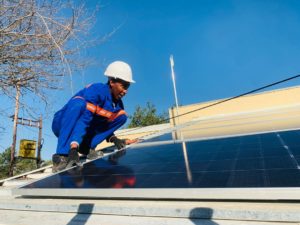
Harnessing that resource through solar photovoltaic and solar thermal technologies can support businesses, institutions, communities and public infrastructure while contributing to the country’s transition towards a more sustainable energy future.
But the opportunity is bigger than installing solar panels.
A mature renewable-energy ecosystem can create opportunities across engineering, manufacturing, research and development, operations and maintenance, technology services, skills development and entrepreneurship.
This is where the clean-energy transition intersects with the broader ambitions of economic diversification.
From solar electricity to solar heat
One example is ASE’s work around SolarisKit, an innovative solar thermal technology developed in partnership with a team at the University in Edinburgh United Kingdom and now a spin out company.
SolarisKit has developed flat-pack solar thermal collectors designed to harness sunlight to produce hot water. The technology has been deployed in several countries, including across Africa, and is designed around accessibility, simple installation and scalable clean heating.
Through the ASE / SolarisKit partnership, this technology is being explored within Botswana’s health, hospitality and clean-energy landscape.
The partnership formed part of the integrated solar technology deployed at Villa de Chazha Guesthouse in Francistown, where solar PV and solar thermal technologies demonstrate how different forms of renewable energy can work together to reduce reliance on conventional energy sources, saving money and reducing climate impacts at the same time.
For Botswana’s health and hospitality sectors, this presents a particularly relevant opportunity. Hot water is an everyday energy requirement you cannot had a modern fit for purpose health sector or hospitality sector without access to reliable, affordable hot water service. Using the country’s abundant solar resource to meet part of that demand can create both environmental and operational benefits.
Solar thermal therefore expands the conversation beyond “solar electricity” to “solar energy”, recognising the many ways Botswana can harness its natural solar resource.
The role of the Botswana International University of Science and Technology (BUIST).
Technology alone does not create a diversified economy. Knowledge, research and people do.
This is why collaboration between industry and institutions such as the BUIST is so important.
BUIST and the Diamonds for Development Fund have already identified areas of potential collaboration including renewable energy and solar power, tourism, agriculture, manufacturing and mining. The University has highlighted the importance of becoming more research-intensive, fostering innovation and strengthening the connection between research, product development and the private sector.
This creates an important space for partnerships between academia, industry, government and technology innovators.
For ASE, partnerships with academic and research institutions both with our international and local partners we are creating a pathway from research → proof of concept → commercialisation → local deployment → skills development and new employment opportunities in the clean technology and services sector.
That pathway is critical if Botswana is to capture more of the economic value created by new technologies.
From importing technology to building capability
The long-term opportunity is not simply to bring international technologies into Botswana.
It is to ask:
How can Botswana learn from, adapt, research, manufacture, operate and eventually export the technologies it needs for its own development?
Solar thermal technology provides one example.
The broader clean-energy sector provides many more including solar PV, battery storage, smart energy management, energy efficiency, electric mobility and other climate technologies.
Each represents an opportunity to develop Batswana skills, businesses and intellectual capital around a growing global industry.
This is where initiatives such as the Diamonds for Development Fund and partnerships with universities and private-sector innovators can potentially intersect.
Making the diamond legacy shine beyond mining
Botswana’s diamond story has always been about value.
The next chapter can be about converting that value into knowledge, innovation, infrastructure, skills and sustainable industries.
The Diamonds for Development Fund’s stated focus on economic diversification and a knowledge-based economy provides a framework for that ambition.
For African Sun Energy, the clean-energy transition is part of this bigger national conversation.
Our diamonds can finance development.
Our sunshine can power it.
Our universities can develop the knowledge behind it.
And our people can build the industries that sustain it.
As Botswana looks towards its next decades of development, the opportunity is to ensure that the country’s natural wealth creates value not only today, but for generations to come.
From diamonds in the ground to diamonds in the sky, Botswana’s future can be powered by both.
African Sun Energy
Harvesting Botswana’s Diamonds in the Sky.
Media Contact:
Tachenama Nomsa Pusoetsile
Marketing & PR Officer
African Sun Energy
Email: pusoetsile@africansunenergy.com | Phone: +267 2404895